Discounts don't build loyalty. They train cheap behavior.
Price-led strategies produce traffic. They do not produce customers. The distinction between those two things is the difference between a business that grows and one that is permanently dependent on the next promotion to stay full.
The case for running discounts feels rational in the moment. Traffic is slow. A promotion generates covers. The room fills. The numbers look better for that week, and the operator moves on. What does not appear in that week's numbers is what the promotion just taught every guest who walked through the door: that this place is worth less than what it normally charges. That lesson does not disappear when the promo ends. It gets reinforced every time the discount returns, and over time, it reshapes the customer base an operator is actually building.
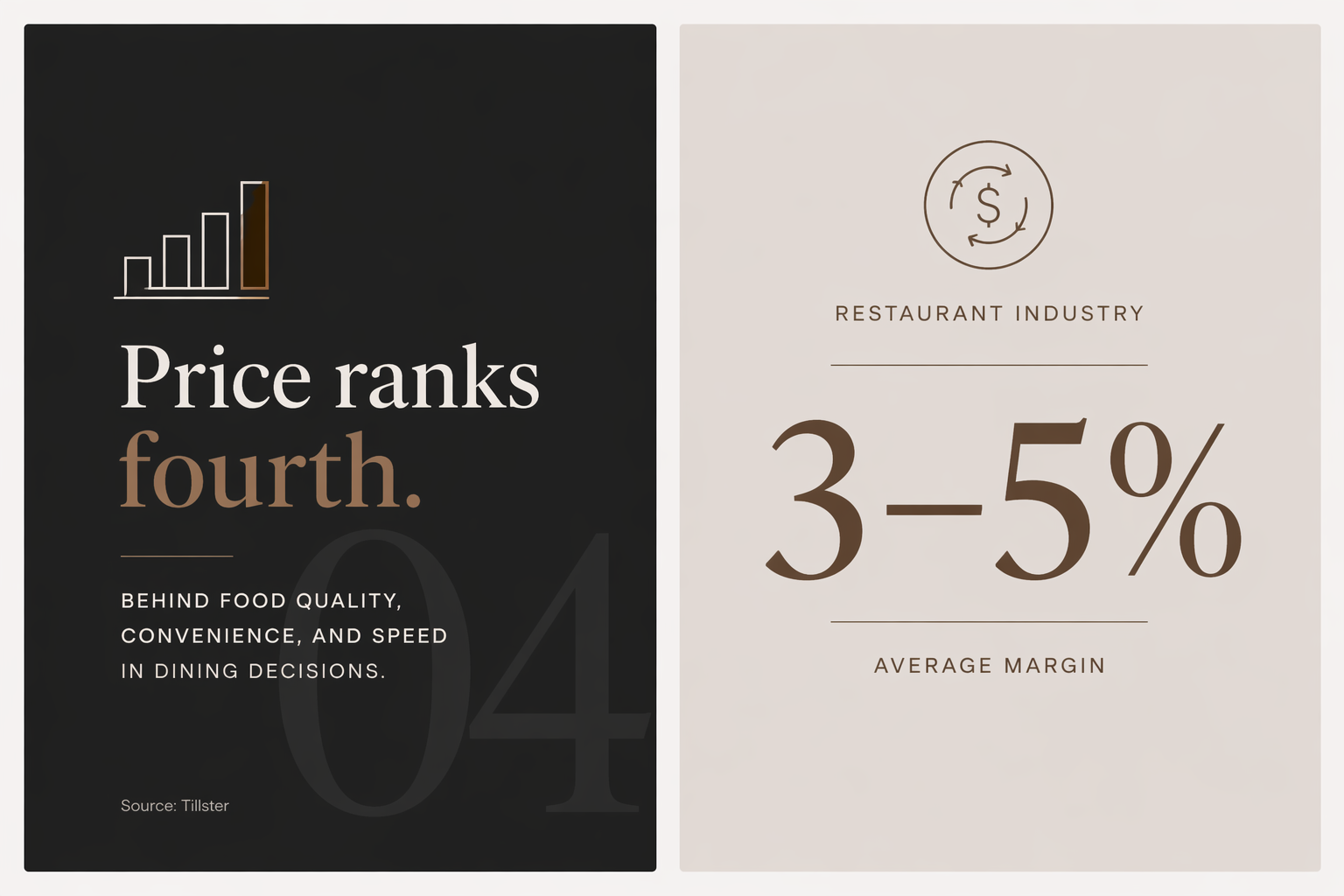
The data support the concern. Consumers now list price as the fourth-most important factor in deciding where to dine, behind food quality, convenience, and speed, according to Tillster. Guests are not primarily driven by price. They are driven by experience and value. Yet the promotional strategies most operators deploy are built around price as the primary lever, which means they are optimizing for the factor guests care about least while simultaneously training a segment of the customer base to only show up when the deal is active.
The restaurant industry operates on margins of 3 to 5% on average. A poorly structured promotion does not just reduce revenue for that period. It can eliminate the margin entirely on every cover it drives. And it does something more damaging than the immediate financial hit: it builds a mixed customer base with a growing percentage of traffic that is discount-dependent, price-sensitive, and unlikely to return at full price. The operators who understand this are not running fewer promotions because they are contrarian. They are running fewer promotions because they have done the math on what those promotions are actually building.
What this means for operators
You are not building a customer base. You are renting one.
Discount-driven traffic has a specific behavioral profile. These guests are deal-prone rather than brand-loyal, and research is consistent on what separates the two: loyal customers are demonstrably less price-sensitive, stabilize revenue streams, and resist competitive offers even when those offers are objectively better. Deal-prone customers respond to price reductions and move on when the reduction disappears. When an operator runs repeated promotions without a strategy to convert those guests into loyal ones, they are not growing a customer base. They are cycling through the same price-sensitive pool on repeat while their actual margins erode.
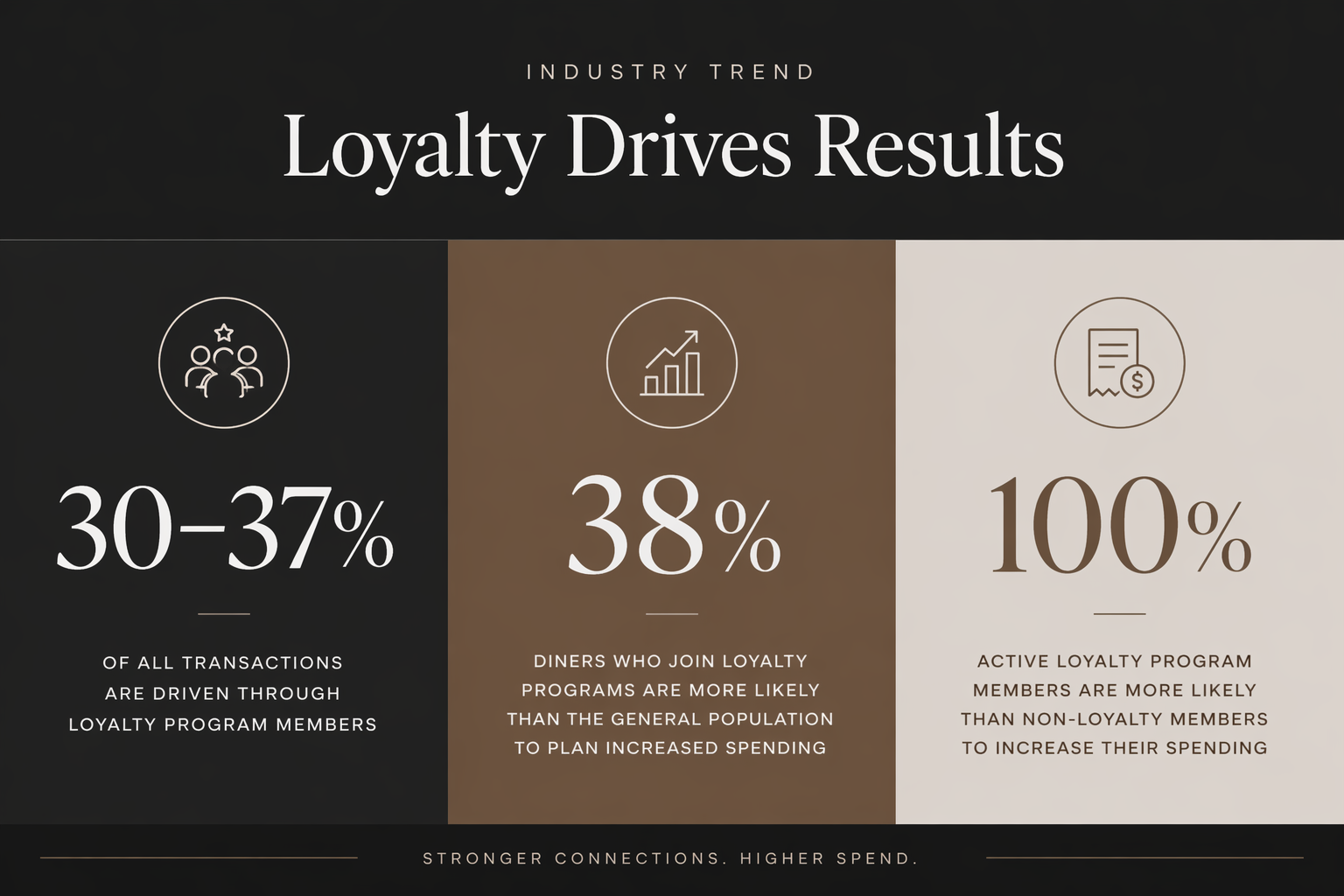
According to Paytronix's 2024 report, top-performing operators drive 30 to 37% of all transactions through loyalty program members. That number represents a fundamentally different business than one relying on promotional traffic. Loyalty members visit more frequently, spend more per visit, and require less marketing investment to retain. Klaviyo's 2025 restaurant marketing report found that diners who join loyalty programs are 38% more likely than the general population to plan increased spending over the next six months. In addition, active loyalty program members are also 100% more likely than non-loyalty members to increase their spending. The guests most likely to grow with the business are the ones operators are least focused on acquiring when they are running discount campaigns to fill immediate capacity.
The structural damage from price-led strategies also compounds over time. High spenders, the guests with the highest lifetime value, are not motivated by discounts. According to the same Klaviyo report, they are 29% more likely to be influenced by personalized recommendations than the general population. Running blanket promotions to attract volume actively de-prioritizes the segment that produces the highest return, while investing marketing energy in guests who will not pay full price. That trade-off is rarely articulated clearly, but it is happening in every operation that treats discounting as a default growth strategy.
What operators should do
Separate promotional strategy from loyalty strategy and treat them as distinct systems
Promotions are acquisition tools. Loyalty programs are retention tools. Running promotions without a mechanism to convert deal-driven guests into loyalty members means every promotion is a cost center with no long-term return. The two systems need to work together, with the promotion serving as the entry point and the loyalty structure doing the conversion.
An operator who runs a first-visit discount tied to loyalty enrollment captures the guest's data, sets an expectation of a relationship, and gives themselves the ability to communicate with that guest after the deal is done. An operator who runs the same discount with no enrollment step gets the cover and nothing else.
Audit your current customer mix and identify what percentage of your traffic requires a promotion to visit
Most operators do not know this number, which means they do not know how dependent their business has become on promotional activity to sustain volume. Without that data, it is impossible to make a deliberate decision about how much promotional traffic is acceptable versus how much loyalty-driven traffic the business needs to be sustainable.
Operators who review POS data and find that 40% of covers over the past quarter came in on a promotional offer are looking at a business where nearly half the traffic has been conditioned to expect a discount. That is not a customer base. That is a liability that disappears the moment the promotions stop.
Build value through experience and recognition, not through price reduction
Loyalty is built on how guests feel, not how much they saved. Personalized communication, recognition of visit frequency, exclusive access to events or menu items, and consistent quality create the kind of attachment that makes guests price-insensitive. These mechanisms cost far less per retained guest than repeated discounting and produce a guest who stays when the price goes up.
Full-service restaurants that send a personalized message to a guest on their fourth visit, acknowledging what they ordered last time and suggesting something new, create more loyalty than a 20% off promotion. The guest feels known. That feeling can’t be replicated by a competitor offering a better deal.
When you do run promotions, tie them to behavior rather than blanket discounts
Behavior-linked offers, such as rewards after a set number of visits, bundled menus that increase check size while delivering perceived value, or time-specific offers tied to low-demand periods, drive the outcomes operators actually want without training the entire guest base to expect reduced pricing. The guest earns the reward rather than receiving it unconditionally.
A promotion that offers a free dessert after five full-price visits rewards loyalty without discounting the base experience. It increases visit frequency among guests who are already inclined to return, and does not attract deal-prone guests who will disappear after redeeming the offer once.
Track customer lifetime value, not just covers, as the primary measure of promotional success
A promotion that fills 30 seats tonight but produces zero returning guests at full price has a negative return on investment that never appears in the nightly revenue figure. Operators who measure what happens to those guests in the 60 days after a promotion are making a fundamentally different decision about whether to run it again.
Two promotions drive the same number of covers in a given week. One produces a 35% return rate at full price over the following month. The other produces an 8% return rate. Those are not equivalent promotions. The first built something. The second filled a room once and trained those guests to wait for the next deal.
What this means for consumers
The deal you chased might be costing you the places worth keeping.
From a consumer perspective, discounts feel like a straightforward win. A deal on a meal that would otherwise cost more is money saved with no apparent downside. But the downstream effect of discount-driven dining behavior has consequences that are less visible and more significant than the short-term savings. When guests consistently choose based on price rather than experience, they are participating in a market dynamic that rewards operators who cut corners to compete on cost and puts the ones investing in quality at a structural disadvantage.
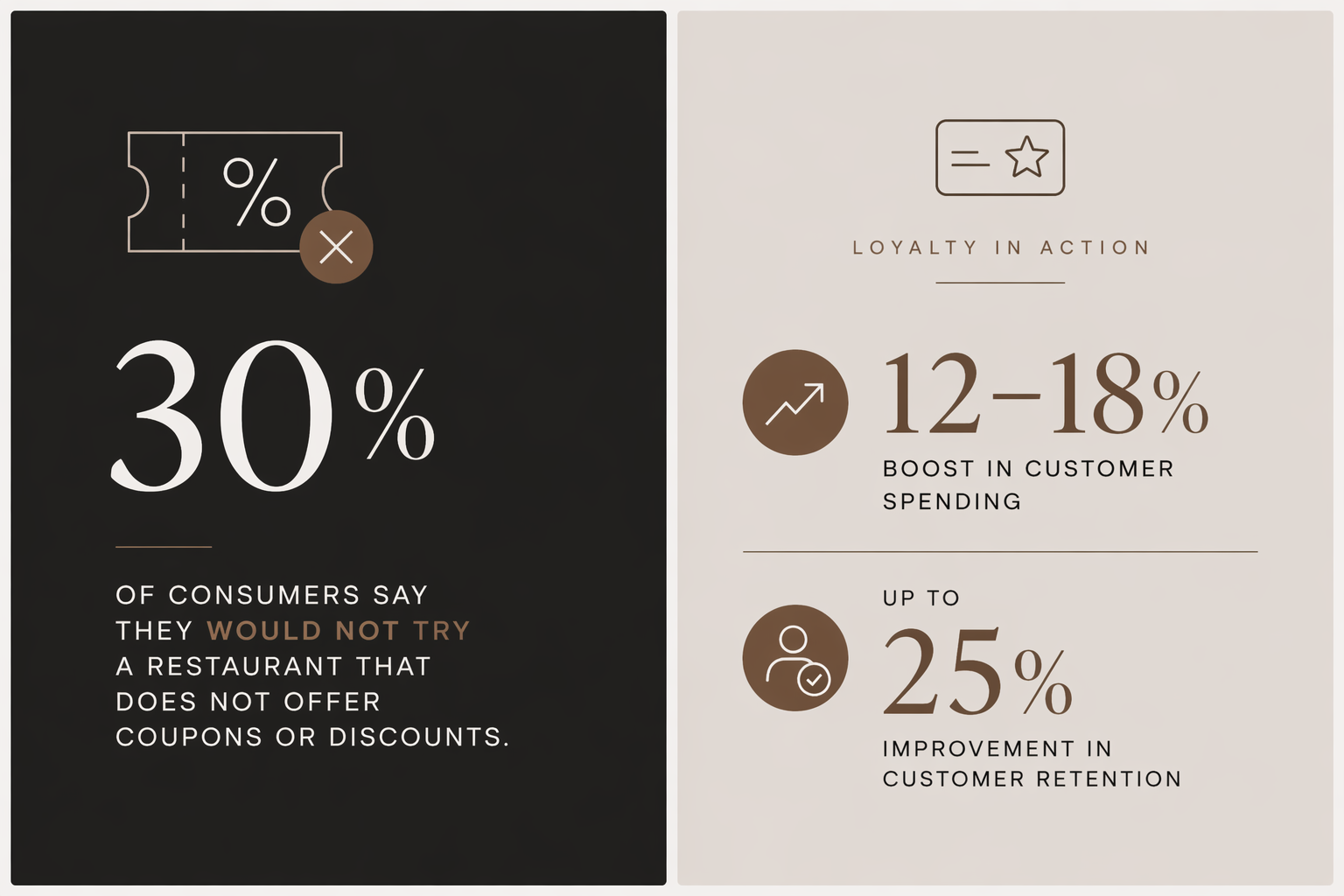
According to Restroworks' 2025 analysis, 30% of consumers say they would not try a restaurant that does not offer coupons or discounts. That is not a preference. That is a conditioning pattern. Guests in that segment have been trained by repeated promotional exposure to evaluate hospitality the same way they evaluate a commodity, purely on price. The businesses that survive that expectation are not the ones producing the best experiences. They are the ones who have figured out how to absorb the margin hit. That trade-off is quiet but real, and consumers are on both sides of it.
There is also what gets lost at the operator level when discounting becomes the default. Well-designed loyalty programs boost customer spending by 12 to 18% and improve retention by up to 25%, according to Chowbus's 2025 loyalty program trend analysis. Those outcomes do not come from guests who show up for deals. They come from guests who show up at the place. When consumers build a habit of returning to the operations they genuinely value, at full price and with frequency, they are funding the quality, the staff retention, and the consistency that made the place worth returning to in the first place. The economics of a good hospitality business depend on that cycle existing.
What consumers can do
Notice the difference between a place you return to because it is good and one you return to because it has a deal
Both can look like loyalty from the outside. Only one of them is. The distinction matters because it tells you something about what you actually value in the experience, and it tells the operator something about whether their business is sustainable or dependent on promotional activity to stay occupied.
If you find yourself checking a restaurant's app for a promo code before every visit, you are not a loyal guest. You are a deal-prone one. That is not a moral judgment. It is a behavioral category, and it is worth knowing which one you are because it shapes how you make decisions and which businesses benefit from them.
Pay full price at the places worth keeping
Independent operators running quality experiences on thin margins do not have the promotional infrastructure of a chain. When a guest extracts every possible discount from a small operator, they are not saving money at no cost. They are reducing the margin that pays the kitchen team, funds the next menu development cycle, and keeps the lights on past the next slow quarter.
A neighborhood restaurant that a guest has visited 20 times at full price has a fundamentally different financial relationship with that guest than one visited 20 times with a promo code applied each time. The first guest is part of why the restaurant is still there. The second guest is part of the pressure that makes it harder to stay.
Engage with loyalty programs that are built around experience, not just points
The best loyalty programs are not discount engines with a different name. They are systems built to recognize guest behavior, personalize communication, and reward the kind of engagement that actually sustains a business. When consumers participate in those programs with genuine frequency, they get a better experience and the operator gets the data to make it better.
A guest who enrolls in a restaurant's loyalty program, visits consistently, and provides feedback when asked is participating in a relationship that improves over time. The operator learns what they want, serves them better, and builds the kind of experience that generates the word-of-mouth no discount campaign ever could.
Share the places you love before they need a promotion to get your attention
Organic word-of-mouth from a genuinely loyal guest is worth more to an independent operator than a paid promotion and costs the guest nothing. A recommendation from someone who pays full price and returns regularly carries a credibility that a discount-driven review does not, and it attracts the kind of guest that the business actually needs more of.
A guest who tells three people about a restaurant they love, with no deal involved, is doing more for that business's long-term health than a promotional campaign reaching a thousand people who will only show up for the offer. The three people came for the place. The thousand came for the price.
The operators building durable businesses are not the ones running the most promotions. They are the ones who understand the difference between filling seats and building guests. Every discount that goes out the door without a retention strategy attached is a cost that never shows up on the P&L and a lesson that never stops teaching. HoCo works with operators to build the loyalty infrastructure, the guest behavior systems, and the pricing strategy that makes promotions a deliberate tool rather than a default response to a slow week.
Sources
Tillster Consumer Preference Report 2026, via Restaurant Dive — Diners are becoming less loyal
Toast Restaurant Profit margin 2025 — Restaurant margin
Klaviyo 2025 Restaurant Marketing Report — Loyalty member spending behavior and high-spender personalization data
Restroworks Restaurant Coupon Statistics 2025 — Consumer discount dependency data
Chowbus Restaurant Loyalty Program Trends 2025 — Loyalty program spending and retention impact
Paytronix 2024 Paytronix Loyalty Trends Report - Loyalty Member transactions